Part of my job this year is to run the STEAM (
Science
Technology
Engineering
Art
Mathematics) Shop at an elementary school on Mondays and Tuesdays. During September and October, I have been working with 1st and 2nd graders. I will work with 3rd, 4th, and 5th graders in November and December. My students come in to my room in small groups throughout the day. In two months, I should be able to see all of the students in the grade levels that are coming to me at that time.
I decided to theme the STEAM activities for the 1st and 2nd graders around nursery rhymes. I have
this set of cards by Modern Publishing that I bought when Boogs was only a year old. I know, I am a bit of a pack rat.
When I tell my students they are going to be working on Science Technology Engineering Art and Math activities based on Humpty Dumpty and Hey Diddle Diddle nursery rhymes, they are in disbelief. I love hearing their comments - No way! Those rhymes are for babies!
First Grade: Our science focus for Humpty Dumpty is magnets. At the beginning of each group's time, we explore magnets, discuss the terms repel and attract, discuss the types of metals that are magnetic, and then the students get one minute to walk the room to see what things in the room their magnets are attracted to.
Then, I take the students over to our stations, explain the challenges, and let them experiment and explore. At the Train Humpty Dumpty to Sit station, each student gets two "pieces of wall" blocks. One block has a magnet glued on top and the other does not. They also each have a very small, but strong magnet. There is a container of pinto beans, a bag of paper strips, markers, tape, and scissors.
The students choose an egg to create their own Humpty Dumpty. They find a way to make their Humpty sit on the wall.
Some students figure out that putting beans inside the egg will help it balance.
This student used the paper strips to make a small stand for Humpty Dumpty.
Some students add arms and legs to provide balance. Some students figure out that putting the small magnet inside their egg will make their Humpty Dumpty attach to the block with the magnet. I love listening to their discussions about how to make it work. They are so excited when their own Humpty Dumpty is able to sit on a wall.
At the Build A Wall For Humtpy Dumpty station, students use their engineering and math skills to predict, build, and measure a wall for Humpty Dumpty. There are five bins of material to use and they must use at least two different kinds of materials in their wall. The materials are things I had available to use - base ten blocks, Jenga blocks, craft sticks, and small communion cups someone donated to the class. The students predict how tall of a wall they can build before they get started.
I encourage them to frequently stop and measure their wall in case it falls.
There are two how-to-measure posters to help the students remember to place their ruler with the zero end on the ground. I have meter and yard sticks so they can measure in centimeters or inches.
It is interesting to see all of the different ways the students make their walls. Sometimes their plan does not work out. FAIL stands for
first
attempt
in
learning.
The students get excited about what they are building and cheer on their classmates to make taller and taller walls.
After clean up time, we quickly debrief. The students help me figure out if we used all parts of STEAM for Humpty Dumpty. S-magnets, T-students use iPhone and iPad to take pictures of their work, E-building the wall, A-creating and decorating Humpty Dumpty egg, M-measurement. We give ourselves a big pat on the back for making STEAM work with the Humpty Dumpty nursery rhyme. The students are very excited that they get to take home the Humpty Dumpty they made in the STEAM Shop.
Second Grade: Our science focus for Hey Diddle Diddle is phases of the moon. At the beginning of each group's time we discuss the phases of the moon - new, crescent, quarter, gibbous, full. Then I take them over to the two stations that focus on the phases of the moon.
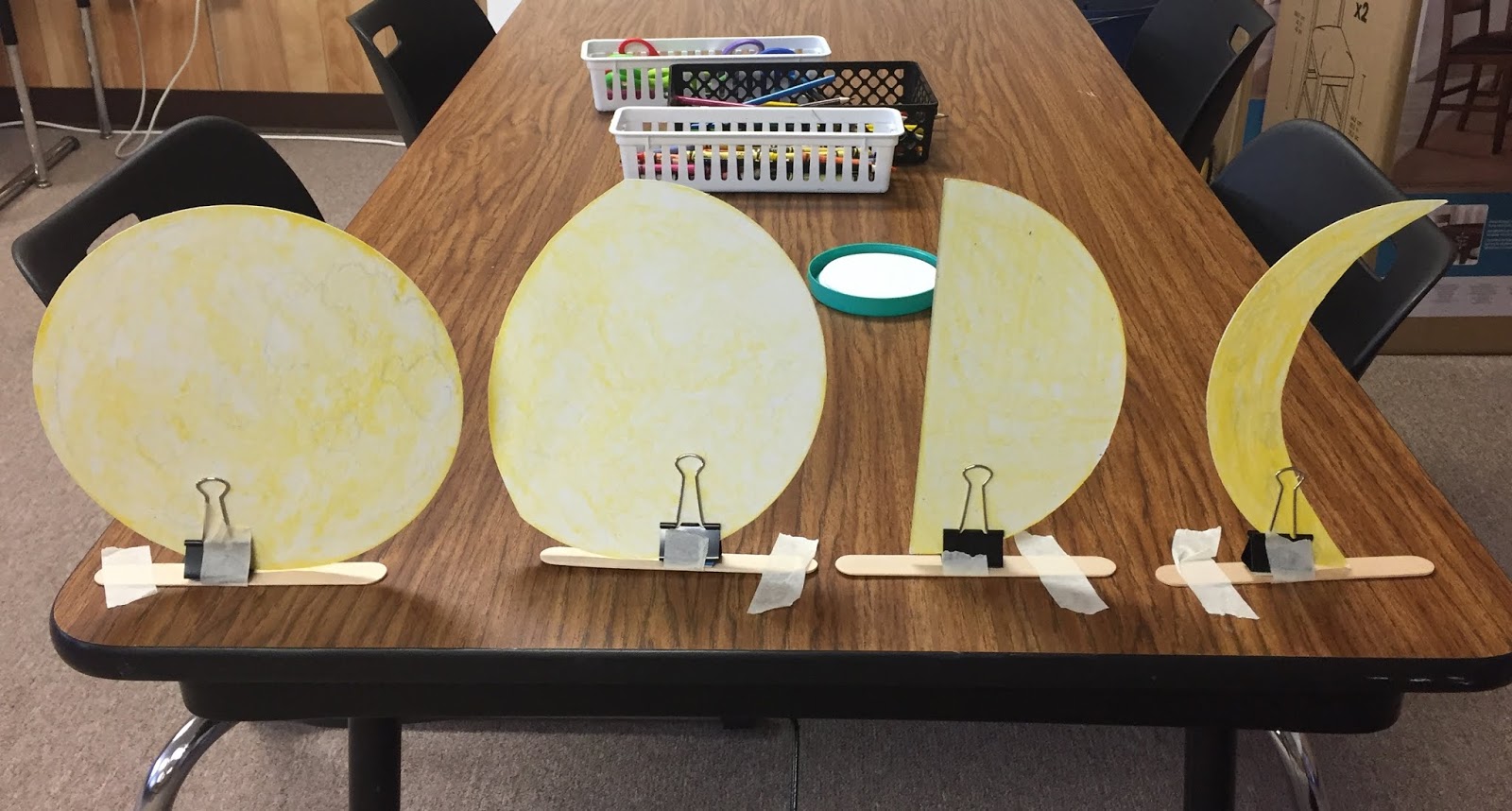
The first station asks the students to decide which phase of the moon they want their own cow to jump over. I have paper circles on the table for students to use as a starting point. They use the poster to help them decide what their moon will look like. There are crayons, colored pencils, pencils, and scissors on the table.
The computer station has a quick moon phase matching game. The students can pick how many matches they want to attempt, from 2 to 8.
HERE is the link.
Helping the cow jump over the moon with a catapult has been the students' favorite station.
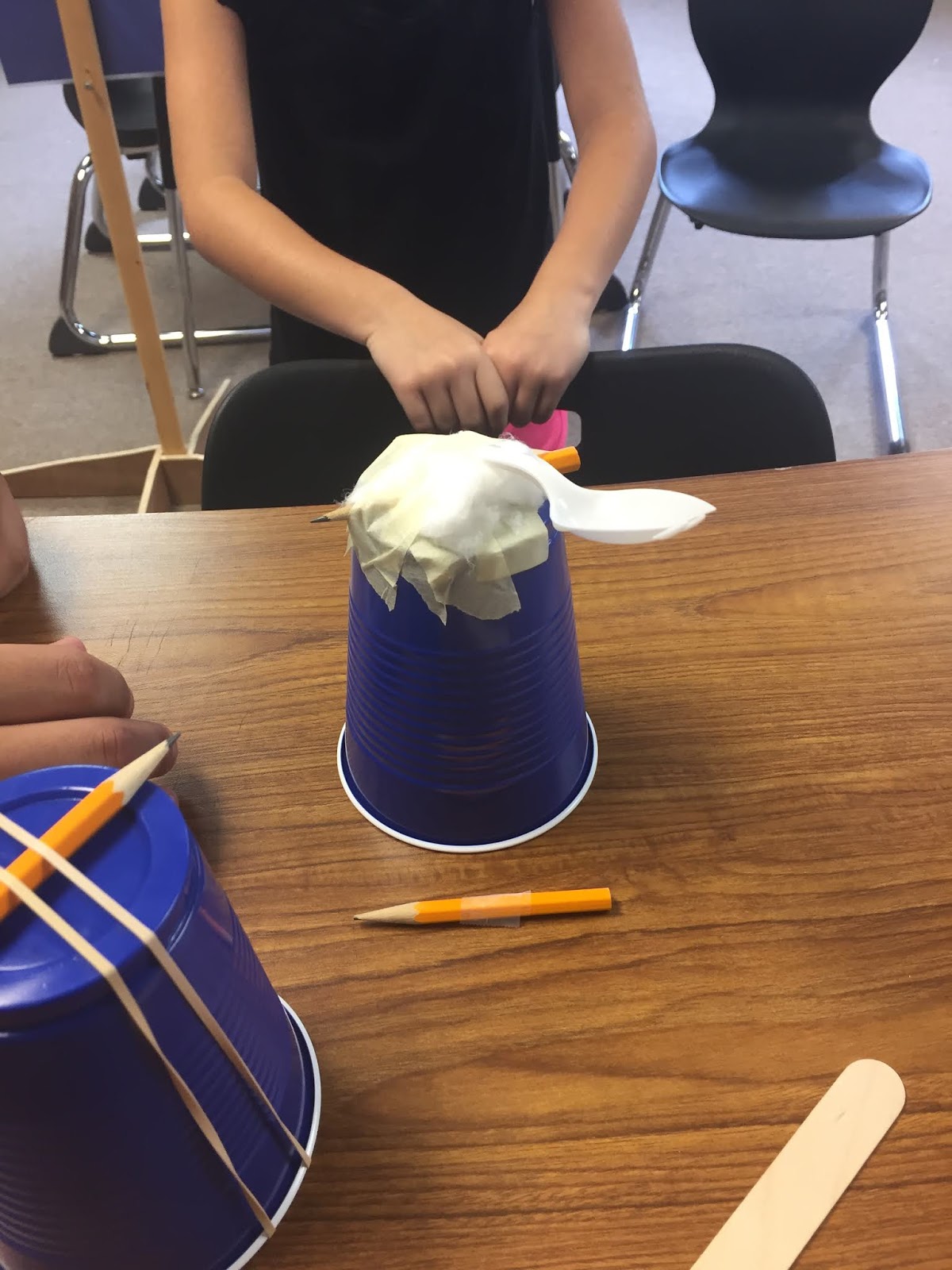
I make sure to tell the students about our corral of cows (cotton balls). The students use the available materials any way that they want to make a catapult. I have pictures of 8 different catapults and a book about catapults for inspiration. The materials are: craft sticks, golf pencils, rubber bands, water bottle lids, spoons, cups, masking tape, and binder clips. I have a hot glue gun that only I can use to glue things together for them.
The students make their catapult, launch a cow, measure the cow's jumping distance, and launch again to see if they can beat that distance. If they have extra time before our class ends, they can design a second catapult and compare its performance to their first catapult. I tell my students they will only be able to take home one catapult, they will have to use critical thinking skills to determine the criteria for choosing which catapult to take home. The rejected catapult must be taken apart so that my next group can reuse the supplies.
I love looking at the variety of their designs. Some are simple, two rubber bands holding a spoon to a cup. Some are more complex using many, many more materials.
I'm very glad we are in a portable building away from other classes when the cows are launched. The noise volume and excitement in the room gets very high. I taped down four phases of the moon in our launch pad area. The students sit behind the start line and launch their cows. They help each other figure out how far their cows jumped using yard sticks and meter sticks. Some catapults require adjustments in the angle of their levers. We discuss force and motion while they are making and testing their catapults.
This student decided to hot glue her full moon phase to the end of her catapult so that her cow jumps over the moon every time she launches it.
After clean-up time, we debrief. The students help me figure out if we used all parts of STEAM for Hey Diddle Diddle. S-moon phases/force/motion, T-moon phase matching game on computer, E-building catapults, A-creating their own phase of the moon, M-measurement/angles/comparing distances. We give ourselves a big pat on the back for making STEAM work with the Hey Diddle Diddle nursery rhyme. Each student takes home one cow, one catapult, and one moon phase.
Early finishers are able to help others or work at the felt board. I have a large
set of felt nursery rhymes I purchased when my 12-year-old was a toddler. I put the pieces for Humpty Dumpty, Hey Diddle Diddle, and Jack & Jill in a bowl for the kids to sort onto the correct story back drop. This activity also encourages re-reading of the nursery rhymes for fluency.
I don't know who has more fun, me or my students. I have two more weeks to decide what activities to do and to gather supplies for the 3rd, 4th, and 5th graders coming to STEAM Shop in November. I better get to work.
This post is linked to: